
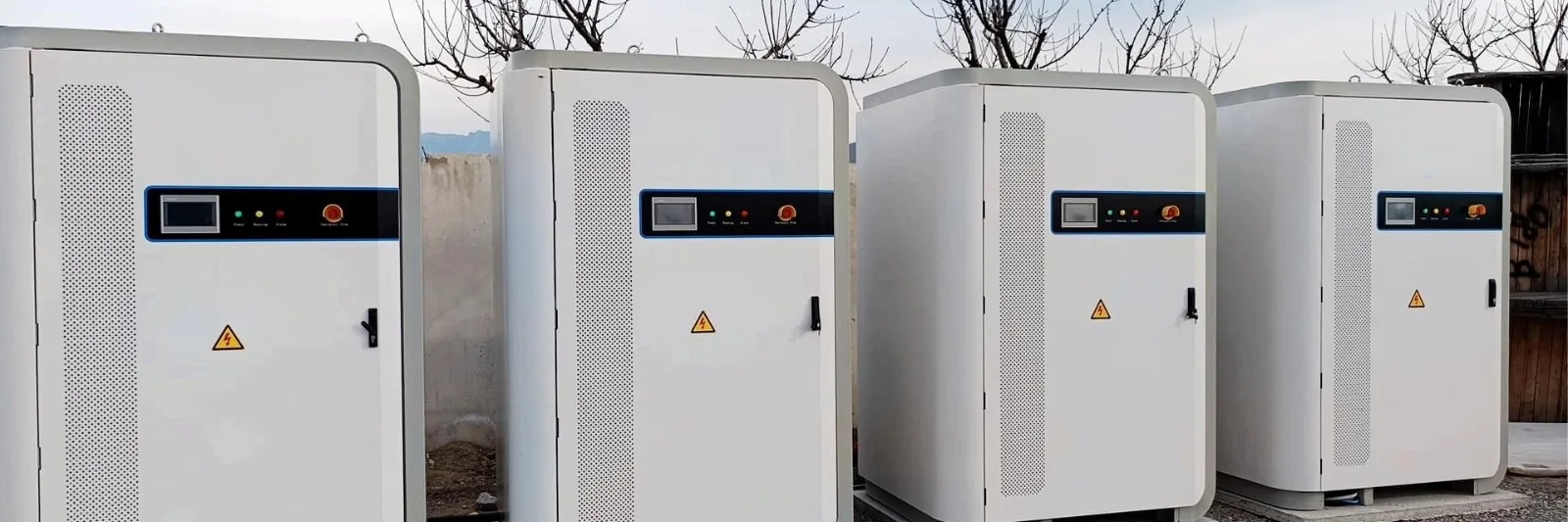
Battery in a cabinet
The compact version for indoors or against a facade, for businesses with a limited peak.
The cabinet is the smallest of the three versions: a unit about the size of a substantial server rack, which can stand indoors or against a facade.
This is the form that suits a business with a clear but limited peak. A workshop with a few heavy machines, an office building with charge points in the car park, a shop with refrigeration.
Where it goes
Indoors is possible, provided it can be ventilated and the floor carries the weight. Outdoors against a facade is also possible, in a version built for it.
The location is not a detail. There are requirements on the distance to escape routes, to flammable storage and to the property boundary, and those differ per municipality and per insurer. That is worked out before anything is ordered, not afterwards.
Fire safety
Every system has its own detection and suppression and a housing that has been tested. What is needed on top of that in structural measures depends on where it stands and what stands next to it.
Your insurer wants to know about this. Report it before the installation is in place: a system reported afterwards can lead to discussion at exactly the wrong moment.
When a container is the better choice
If your peak is larger than one cabinet can deliver, or if you expect your capacity to grow over the coming years. Several cabinets side by side is technically possible, but at a certain point a container is cheaper per stored kilowatt hour and simpler to maintain.
What it costs in maintenance
A battery system has no moving parts apart from the ventilation, and that saves on maintenance compared with almost any other installation in a business building. What it does need: an annual check of the detection, the protection and the connections, plus monitoring of the condition of the cells.
That condition declines slowly, and that is normal. What you want to know is whether it declines faster than expected, and you only see that if somebody looks. Without checks you notice the decline only when the saving disappoints.
Why the measurement comes first
The size of a cabinet follows from your peak, and almost nobody knows theirs without measuring. How that works and what comes out of it is under energy monitoring; why that step cannot be skipped is explained in the piece on solving grid congestion.
Goes with this
Parts that in practice are nearly always looked at together.
Battery in a container
The version for larger peaks, sited outdoors, from a few hundred kilowatt hours to several megawatt hours.
Mobile battery
Temporary capacity where there is no connection, or where the connection cannot carry it.
Charging infrastructure for business
Charge points for your fleet, your staff or your visitors, sized on what your connection can take.
Not sure what you need?
Describe what is happening at your location. Working out what fits is our job, and we will tell you if it does not pay for itself.