

Back contact solar panels
All current-carrying lines on the back, so an even black front and less loss when shade falls across it.
On an ordinary solar panel the current-carrying lines run across the front. Those lines intercept light that would otherwise have reached the cell, and they are visible as a fine silver grid across the panel.
On a back contact panel both poles sit on the back. The front is therefore one even black surface, with not a single line falling across the active area.
Our back contact panels form the Onyx range, with the watt-peak figure after the name: Onyx 475, Onyx 545 and Onyx 660. That figure is exactly what you compare on.
What it gives you in heat
The temperature coefficient is −0.26% per degree. Every degree above 25 °C therefore costs a little over a quarter of a percent in output.
On a summer day a roof easily reaches 50 degrees, and that difference adds up. It is not a large number, but it recurs every year.
How it looks
An even black surface with no grid. For anyone who sees the roof from the street, that is the difference between panels that stand out and panels that do not.
That is a matter of taste and not a technical argument, but for many people it is the reason they choose this technology. There is also a version with a white backsheet, which delivers slightly more and stands out more.
When not to choose this
On a large roof without shade and with room to spare. The efficiency difference is made up there with one extra panel, and that costs less than the premium on the technology.
If you buy on price per watt-peak, half-cut is the logical choice. If you want maximum output per square metre and have little shade, look at multicut.
The comparison of all three is at solar panels.
Specifications
- Power
- 465 to 475 W (E-Class, 54 cells), up to 545 W and up to 660 W in the larger versions
- Efficiency
- up to 23.8% (54 cells), up to 24.4% in the largest version
- Cell type
- N-type back contact, bifacial
- Bifaciality
- 75% ±5%
- Power temperature coefficient
- −0.26 %/°C
- Glass
- 2.0 + 2.0 mm heat-strengthened, anti-reflective coating on the front
- Junction box
- IP68, 3 bypass diodes
- Manufacturer warranty
- 25 years product and 30 years power on the 475 W version, 15 and 30 years on the two larger ones; at least 99.0% in year 1
- Annual degradation
- 0.35% maximum
These figures come from the manufacturer datasheets and apply under standard test conditions. What an installation delivers at your site depends on your roof, your consumption and your connection; we work that out during the measurement.
The range
The same technology in several sizes. Which one fits you follows from the calculation; this is what there is to choose from.
Onyx 475
The size for an ordinary house. It fits nearly every roof, comes in an evenly black version for anyone who sees the roof from the street, and carries the longest product warranty of the three: 25 years instead of 15.
What those figures mean
- 475Wpeak power
- The most a single panel delivers, measured in the factory under full sun straight onto the panel at 25 degrees. On a real roof you reach that only at the best moments of the day.
- 23.8%efficiency
- Of all the sunlight landing on the panel, this share comes out as electricity. The higher the figure, the less roof area you need for the same yield.
Onyx 545
The size for a commercial roof. The panel is larger, so you need fewer of them and fewer mounting points per kilowatt-peak. White glaze only, because looks are not the deciding factor there.
What those figures mean
- 545Wpeak power
- The most a single panel delivers, measured in the factory under full sun straight onto the panel at 25 degrees. On a real roof you reach that only at the best moments of the day.
- 23.5%efficiency
- Of all the sunlight landing on the panel, this share comes out as electricity. The higher the figure, the less roof area you need for the same yield.
Onyx 660
The largest of the three and the most sparing with space, meant for large roofs and ground-mounted arrays. Do check the warranty: this panel carries 15 years on the product instead of 25.
What those figures mean
- 660Wpeak power
- The most a single panel delivers, measured in the factory under full sun straight onto the panel at 25 degrees. On a real roof you reach that only at the best moments of the day.
- 24.4%efficiency
- Of all the sunlight landing on the panel, this share comes out as electricity. The higher the figure, the less roof area you need for the same yield.
Outputs, efficiencies and warranty terms come from the manufacturer datasheets and warranty documents and apply under standard test conditions. Terms can differ per country; what applies to your installation is stated in the quote.
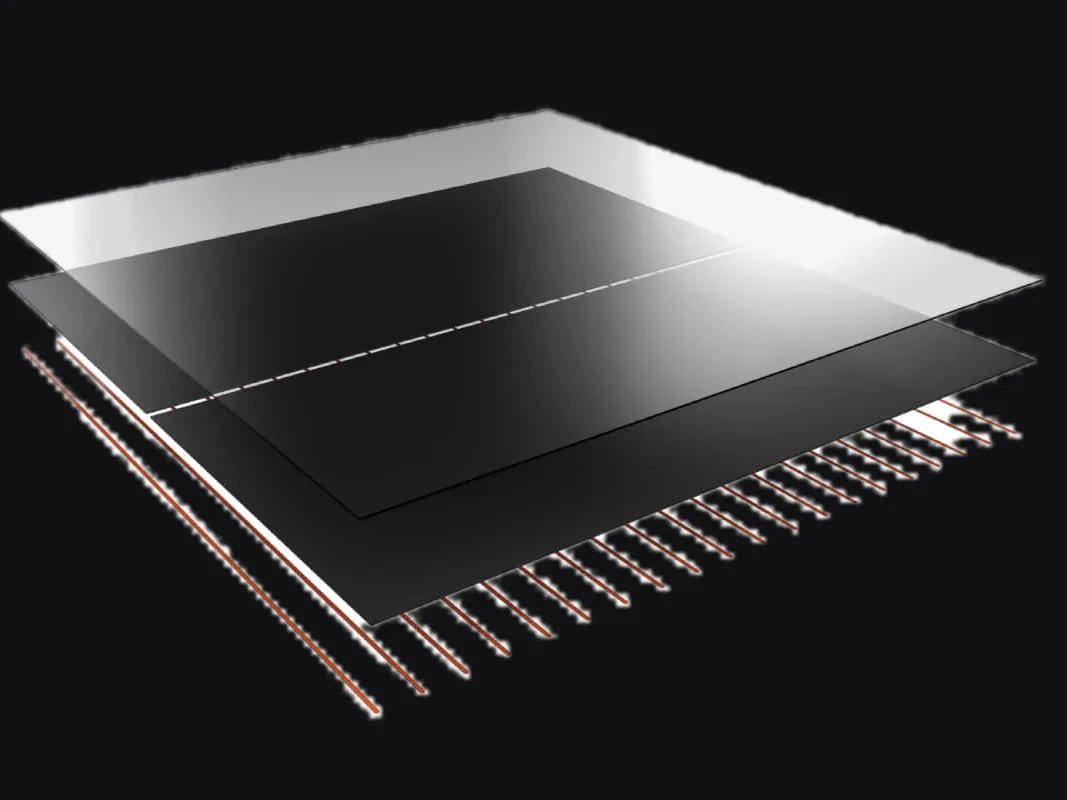
What sits on the back
On an ordinary panel the current-carrying lines run across the front. Those lines intercept light that would otherwise have reached the cell, and they are visible as a fine silver grid.
On a back contact panel both poles sit on the back. The front is therefore one even black surface, with not a single line falling across the active area.
That is not only a matter of looks. Without lines across the cell there is more surface converting light, and that shows in the output per square metre.
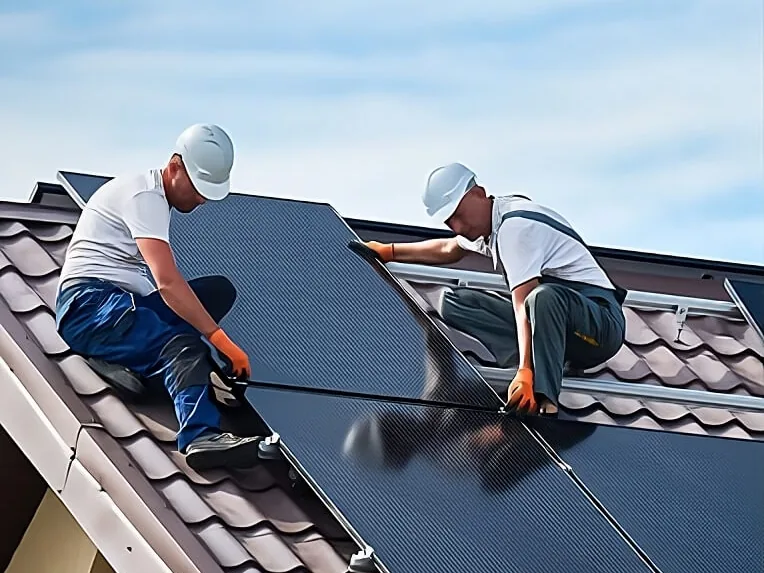
What it gives you in shade
This is where the technology sets itself apart, and it is not about the lines but about how a shaded cell behaves.
In an ordinary panel one shaded cell drags the whole string down: the cell starts working against the others, and the rest delivers less as a result. In a back contact panel each cell can effectively bypass itself, keeping the loss limited to the part genuinely in shadow.
In practice: a chimney casting a morning shadow across two cells costs you two cells, not half a string. How much that saves you is not fixed and comes out of the yield calculation, where we set your roof side by side with and without this technology.
Goes with this
Parts that in practice are nearly always looked at together.
Multicut solar panels
Cells cut into thirds and overlapped like roof tiles. No dead space between cells and the highest efficiency of the three.
Half-cut solar panels
The proven standard, tested for salt mist, hail and ammonia. The lowest price per watt-peak of the three.
EPOWER Energy Manager
One unit that gets your panels, your battery, your charge point and your heat pump to work together on the cheapest hour.
Not sure what you need?
Describe what is happening at your location. Working out what fits is our job, and we will tell you if it does not pay for itself.