

Solar panels for business
A commercial roof full of panels rarely runs into a problem with the roof. It runs into a problem with your connection.
A commercial roof will almost always take more than your connection can export. That is the heart of this subject, and it is why a business solar quote rarely starts at the roof.
It starts at your connection capacity and at what the grid operator allows in the way of export.
Where it runs aground in practice
The export limit. Across large parts of the Netherlands the grid operator no longer has room for new export, or only under conditions. A roof full of panels that is curtailed half the year is an investment you use half of.
Your own consumption pattern. Panels deliver during the day. If your business runs from eight to five that lines up nicely; if you run shifts or work at night, generation passes your consumption by.
The structure. A flat commercial roof is designed for snow and wind, not automatically for fifty tonnes of panels and ballast. That is checked before a quote is written.
Which panels
On a large roof the price per watt-peak weighs more heavily than the efficiency per square metre, because space is usually not the constraint. Half-cut panels are then the obvious choice, our Field range, in the large version up to 725 W.
If you have little roof and high consumption, multicut wins with up to 755 W per panel: the Ridge range. And on the coast or on an agricultural site, the testing list of half-cut is the argument rather than the yield.
What comes first
A quarter-hourly measurement on your main connection, a structural check on the roof and an enquiry with your grid operator. Those three together decide what is possible, and only after that does it become a conversation about panels.
We name no yield in euros before those three are in. That is not caution: a calculation without the export limit in it is simply wrong, and that only shows once the installation is on the roof.
If the problem is wider than your roof, read solving grid congestion. For the measurement itself: energy monitoring.
Specifications
- Power per panel
- 455 to 755 W, depending on technology and size
- Highest efficiency
- 24.8% (multicut T5 Pro XL, up to 755 W)
- Large half-cut version
- 700 to 725 W, up to 23.3% efficiency
- Maximum system voltage
- 1500 V
- Maximum static load
- 5400 Pa front, 2400 Pa rear
- Salt mist and ammonia
- half-cut is tested for both; installation up to 50 m from the sea and in agricultural settings
- Manufacturer warranty
- 25 years product and 30 years power on the domestic sizes, 15 and 30 years on the utility-scale versions
These figures come from the manufacturer datasheets and apply under standard test conditions. What an installation delivers at your site depends on your roof, your consumption and your connection; we work that out during the measurement.
Why storage belongs in the same design
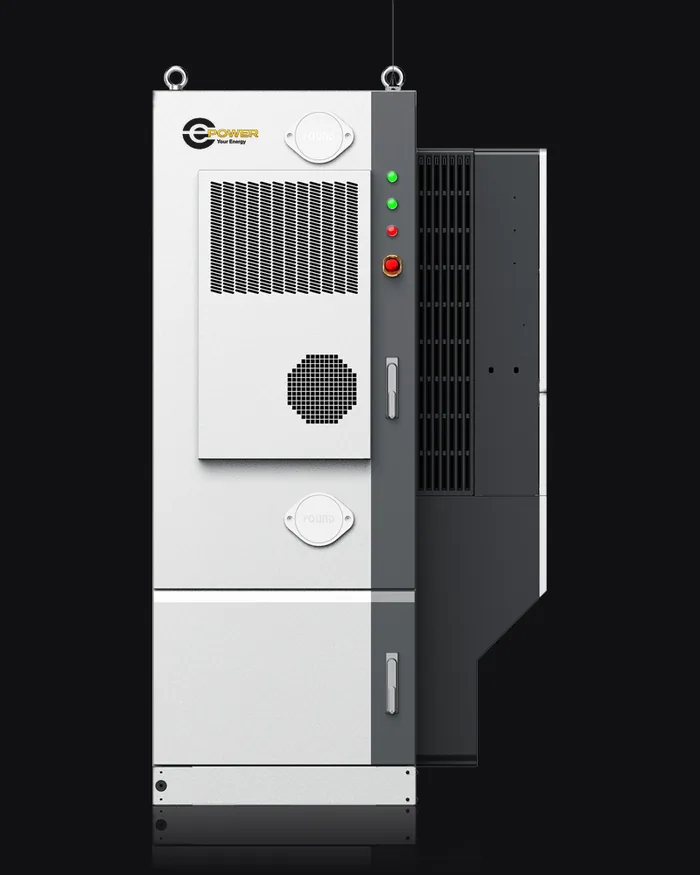
If you may not export and you do not use it immediately, storage is the only place it can go. A business battery absorbs the midday peak from your panels and returns it in the evening or at your morning peak.
That changes the calculation entirely: without storage you count what you use at the moment of generation, with storage you count nearly all of your output.
Even if you add the storage later, it belongs in the design now. The inverter choice and the layout of the distribution board depend on it, and adjusting afterwards costs more than leaving room up front.
Goes with this
Parts that in practice are nearly always looked at together.
Inverters
The conversion from direct to alternating current, and the point where your installation's output is capped in practice.
Generators
Power under your own steam when the grid drops out, plus an honest account of when a generator is not the answer.
Battery storage for business
Store power when it is there and use it when you need it, without your connection having to be upgraded.
Not sure what you need?
Describe what is happening at your location. Working out what fits is our job, and we will tell you if it does not pay for itself.